A Definitive Guide to Fixing Common Data Quality Problems Automatically
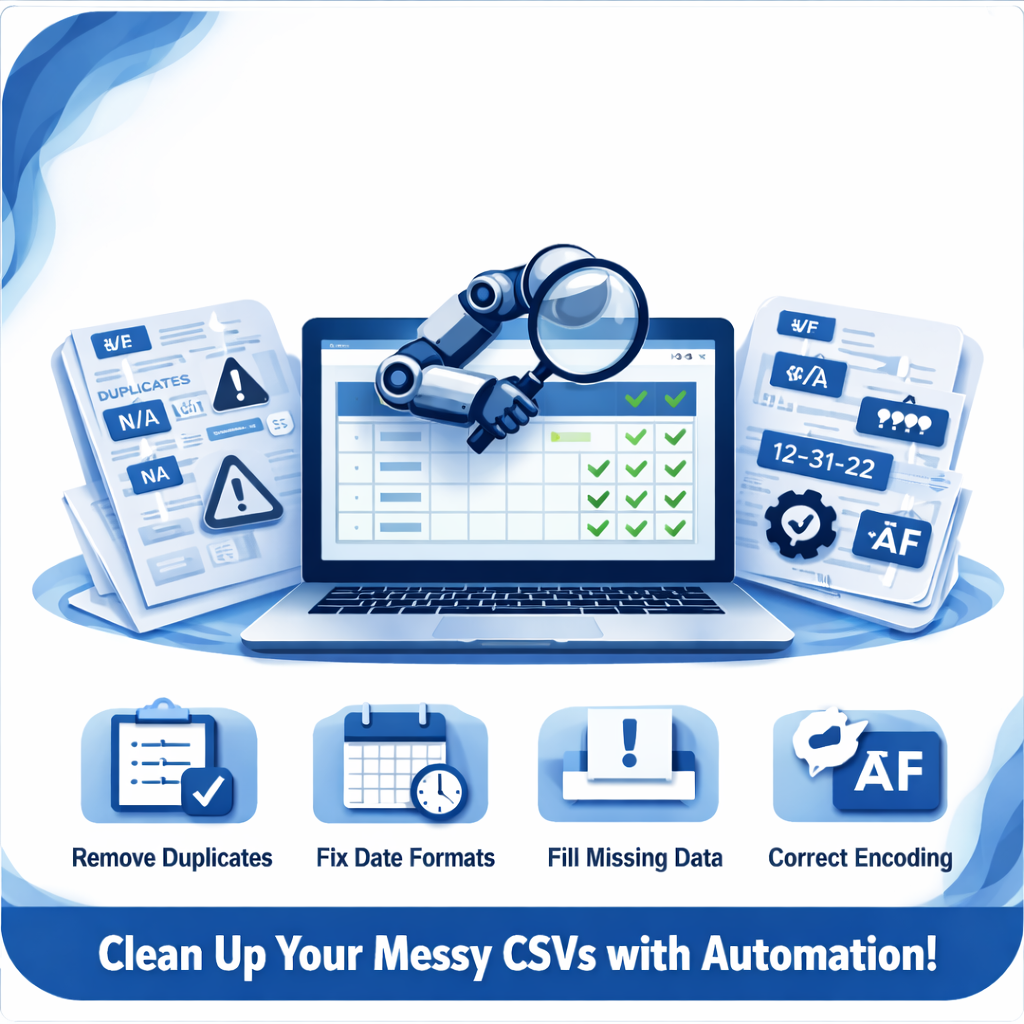
Learn how to fix common CSV data quality problems automatically with CSVNormalize. Discover solutions for inconsistent formatting, missing data, duplicates, and more, transforming your raw CSVs into clean, standardized datasets.
The Hidden Costs of Poor CSV Data: Why Cleanliness Matters
CSV files are the lifeblood of data exchange, yet they are notoriously prone to errors. These pervasive data quality issues, from simple typos to complex inconsistencies, can silently sabotage business operations. The detrimental impact ranges from inaccurate analytics and failed system imports to countless hours wasted on manual data wrangling. Proactively addressing these common CSV data quality problems is not just about tidiness; it’s about safeguarding data integrity, ensuring reliable decision-making, and boosting operational efficiency.
Identifying the Culprits: Common CSV Data Quality Problems Explained
Unorganized, inconsistent, or error-prone CSV files present a significant hurdle for any business relying on data. Before you can truly leverage your data, you need to understand and tackle the most frequently encountered issues that compromise its quality and usability. This section dives into the culprits that make top CSV problems every analyst faces a reality.
Eliminating Redundancy: How to Remove Duplicate Entries in CSV
Duplicate data is a pervasive issue in CSV files, often stemming from merged datasets, re-imports, or data entry errors. These redundant rows can skew analytics, inflate metrics, and lead to inefficiencies, making it crucial to effectively remove duplicate entries in CSV.
The Business Impact of Duplicate Data
Duplicate entries are more than just a nuisance; they lead to inflated metrics, erroneous reporting, and wasted resources across various departments. Imagine sending the same marketing email twice to a single customer, or inaccurate inventory counts – these scenarios directly impact ROI and operational effectiveness, highlighting the critical need for a clean dataset.
Manual Methods for Duplicate Removal
Traditional spreadsheet functions like Excel’s “Remove Duplicates” or Google Sheets’ “Data cleanup” feature can help identify exact matches. More complex scenarios might involve pivot tables or even writing custom scripts in Python or R. However, these methods are often time-consuming, prone to human error, and struggle with large datasets or “fuzzy” duplicates (e.g., “John Doe” vs. “J. Doe”). The process becomes particularly laborious when dealing with multiple files or recurring data imports, making manual deduplication a significant bottleneck.
Automated Solutions for Deduplication
Automated tools like CSVNormalize leverage AI to intelligently identify and remove duplicates with blazing speed and accuracy. Beyond exact matches, its advanced algorithms can detect near-duplicates and inconsistent entries, ensuring comprehensive deduplication across massive datasets. This automation eliminates manual effort, drastically reduces the potential for error, and guarantees a truly unique and clean dataset ready for analysis or system import.
Standardizing for Success: Resolving Inconsistent CSV Formatting
Data consistency is paramount for reliable analysis, yet CSV files frequently suffer from varied data formats (dates, numbers, text) that hinder integration and insights. Achieving universal consistency is key to unlocking your data’s full potential.
The Pitfalls of Inconsistent Data Formats
Inconsistent data formats, such as dates presented as “MM/DD/YYYY” in one column and “YYYY-MM-DD” in another, or numerical values containing different currency symbols, create significant barriers to data integration and analysis. These discrepancies can break calculations, prevent accurate filtering, and lead to faulty reports, making it impossible to gain a unified view of your data.
Manual Formatting Correction Techniques
Manually resolving inconsistent CSV formatting often involves laborious spreadsheet functions like find/replace, text-to-columns, or complex custom formulas. This process is not only time-intensive but also highly susceptible to errors, especially when dealing with diverse formats or large volumes of data. Maintaining consistency across different files or recurring data imports becomes an ongoing, inefficient struggle.
Leveraging AI for Format Standardization
CSVNormalize’s AI-powered system automatically detects diverse data formats within your CSV files and normalizes them to a consistent standard. Whether it’s standardizing date formats, cleaning up numerical entries, or ensuring uniform text casing, the platform intelligently applies the correct transformations. This ensures a uniform structure across all fields, eliminating manual rework and providing data that is instantly ready for analysis.
Bridging the Gaps: Dealing with Missing and Incomplete Data in CSV Files
Missing data, manifested as null values or empty cells, is a common challenge that can severely compromise data integrity. Understanding its implications and implementing robust handling strategies is crucial for accurate insights.
Why Missing Data Compromises Integrity
Gaps in your data lead to biased analyses, incorrect summaries, and operational errors. When critical information is absent, any insights derived from that data are fundamentally flawed, leading to poor decision-making. Whether it’s incomplete customer records affecting marketing campaigns or missing sales figures skewing financial reports, a comprehensive approach to dealing with missing data in CSV files is essential.
Manual Approaches to Missing Data
Traditional methods for handling missing data include manual entry (if feasible), simple imputation (e.g., filling with the mean, median, or a default value), or outright deletion of rows or columns with missing values. While these can offer quick fixes for small datasets, they carry significant risks: manual entry is slow and error-prone, simple imputation can distort statistical distributions, and deletion leads to data loss, potentially undermining the integrity of your dataset.
Intelligent Handling of Incomplete Data
CSVNormalize provides sophisticated, AI-driven solutions for incomplete data. Its intelligent data validation engine can automatically flag missing values for review, or apply advanced imputation techniques based on patterns within your dataset, ensuring data completeness without sacrificing accuracy. This automated approach ensures you retain maximum data utility while eliminating the manual burden and risks associated with incomplete information.
Beyond the Blanks: How to Handle Empty Columns and Rows in CSV
Beyond individual missing values, CSV files often contain entire columns or rows that hold no meaningful data. These seemingly innocuous blanks can add unnecessary overhead and complicate your data workflows.
The Overhead of Empty Data Structures
Superfluous columns or rows, often remnants of data exports or manual edits, create unnecessary data bloat. This not only increases file size and slows down processing but also complicates data schema understanding and maintenance. These empty structures can lead to confusion and inefficiency, highlighting the need for efficient strategies for how to handle empty columns in CSV.
Manual Cleanup of Empty Columns and Rows
Manually cleaning empty columns and rows typically involves scanning spreadsheets and individually deleting them. For large or frequently updated datasets, this process is incredibly tedious and time-consuming. It also introduces the risk of accidentally deleting valuable data or missing truly empty sections, leading to ongoing inefficiencies.
Automated Detection and Removal of Empty Data
CSVNormalize’s efficiently identifies and eliminates truly empty columns or rows from your datasets. Its intelligent algorithms differentiate between intentionally blank fields and genuinely superfluous structures, ensuring that only unnecessary data is removed. This streamlines the dataset, reduces file size, and optimizes performance for all subsequent data operations.
Decoding the Chaos: Fixing Encoding Issues in CSV Data
Character encoding problems are a notorious source of frustration, manifesting as unreadable “garbled text” that can derail data imports and analysis. Understanding and resolving these issues is paramount for data integrity.
The Mystery of Garbled Text: Understanding Encoding Errors
When CSV files are created or opened with incompatible character encodings (e.g., UTF-8, ANSI, ISO-8859-1), the result is often a string of unreadable, garbled characters. This can lead to data loss or incorrect interpretation during import, making your data unusable. Fixing encoding issues in CSV data is essential to restore legibility and ensure accurate data processing.
Manual Encoding Correction Methods
Manual encoding correction often involves opening files in various text editors and painstakingly trying different encoding options until the text appears readable. This trial-and-error approach is not only time-consuming and frustrating but also prone to mistakes, especially for users unfamiliar with character encodings. It’s an inefficient solution for ensuring data integrity.
Automated Character Encoding Resolution
CSVNormalize’s offers automated character encoding resolution. Its advanced system intelligently detects common encoding discrepancies and seamlessly converts your data to the correct format, preserving data integrity without any manual intervention. This ensures your data is always perfectly legible and ready for use, eliminating the headache of garbled text.
Typecasting for Accuracy: Resolving Data Type Mismatches in CSV
Data type mismatches, where information in a column doesn’t align with its expected type (e.g., text in a numeric field), are silent killers of data accuracy, breaking critical functions and leading to faulty analysis.
The Peril of Incorrect Data Types
When numbers are stored as text, or dates as general strings, it creates a cascade of problems. Calculations fail, filters produce incorrect results, and database imports are rejected, leading to critical errors in reporting and analysis. Resolving data type mismatches in CSV is fundamental for maintaining data accuracy and ensuring proper functionality across your data infrastructure.
Manual Data Type Adjustments
Manually adjusting data types in spreadsheets involves using specific functionalities for type conversion (e.g., “Text to Columns,” “Format Cells”). While possible for small datasets, this process becomes incredibly labor-intensive and error-prone for complex or large CSVs. The risk of introducing new errors during manual conversions is high, making it an unsustainable solution for consistent data quality.
Intelligent Data Type Inference and Correction
CSVNormalize’s’s AI-powered platform automatically infers the correct data type for each column, even across diverse entries. It then applies consistent and accurate conversions, preventing common import failures and ensuring your data is always correctly structured. This intelligent approach saves immense time and dramatically improves the reliability of your data for any application.
Manual vs. Automated: The True Cost of Fixing CSV Errors
The choice between manual and automated CSV data cleaning is a critical one, with significant implications for efficiency, accuracy, and overall business costs. Understanding this trade-off is key to optimizing your data preparation workflows.
The Time Drain and Error Risk of Manual CSV Cleanup
Traditional manual CSV cleanup methods are fraught with hidden operational costs. They demand significant time and effort from skilled personnel, diverting valuable resources from core tasks. Beyond the time drain, the high probability of human error in manual data preparation leads to recurring mistakes, unreliable data, and ultimately, flawed business decisions. This constant firefighting makes manual cleanup an unsustainable and expensive long-term strategy.
The Efficiency and Accuracy of AI-Powered Data Normalization
AI-powered data normalization platforms like CSVNormalize’s drastically reduce preparation time, transforming hours or even days of manual effort into minutes. By minimizing human intervention, these tools virtually eliminate errors and deliver consistently clean, ready-to-use data at scale. This efficiency not only frees up valuable resources but also ensures a higher degree of data accuracy, providing a robust foundation for analysis, reporting, and system imports. CSVNormalize’s is truly among the best tools for CSV data cleanup.
Beyond the Fix: Proactive Strategies for Preventing CSV Data Quality Problems
While fixing existing errors is crucial, adopting proactive strategies for data collection, entry, and export can significantly minimize the occurrence of common CSV issues before they even arise.
Establishing Robust Data Entry Guidelines
Implementing clear and standardized data entry guidelines at the source is the first line of defense against data quality problems. This includes defining consistent formats for dates, addresses, names, and numerical values, using dropdown menus where possible, and providing clear instructions to data inputters. Standardizing data input from the outset drastically reduces inconsistencies and errors downstream.
Implementing Pre-Import Validation Workflows
Validating your CSVs against a predefined schema or a set of business rules before attempting imports is a powerful proactive measure. This allows you to catch errors early, preventing bad data from entering your systems. Tools like CSVNormalize’s include built-in validation engines that can automatically check for inconsistencies, missing values, and type mismatches, ensuring your data meets quality standards before it impacts your operations.
Revolutionize Your Data Workflows with CSVNormalize
Don’t let messy CSVs hold your business back. CSVNormalize’s provides an intelligent, AI-driven solution for comprehensively addressing all common CSV data quality problems, from duplicates and inconsistent formatting to encoding issues and missing data. Our platform empowers you to transform unorganized, inconsistent, or error-prone CSV files into clean, standardized, and validated datasets effortlessly. With features like intelligent column mapping, reusable templates, blazing-fast output, and a robust data validation engine, CSVNormalize streamlines data preparation, reduces manual effort, and significantly improves the CSVNormalize’s of your data for analysis, reporting, and system imports. Visit CSVNormalize today and experience the future of data cleanliness and standardization.